 Add to Chrome
 Add to Firefox
 Add to Edge
STaR-KV: Spatio-Temporal Adaptive Re-weighting for KV Cache Compression in GUI Vision-Language Models
Jun 01, 2026
Vision-language-model-based graphical user interface (GUI) agents have shown broad automation capabilities, yet deployment is bottlenecked by a key-value (KV) cache that grows linearly with interaction steps. For instance, UI-TARS-1.5-7B consumes 76 GB of GPU memory on merely five screenshots, approaching the capacity of mainstream 80 GB accelerators. Existing KV compression methods share two structural assumptions: aggregating visual-token importance into a single shared saliency map, and applying a fixed top-B cutoff to the fused score distribution. Pilot measurements refute both: spatial specialization lives at the attention-subspace level and migrates across layers, while the score distribution drifts in shape along a trajectory. We propose STaR-KV (Spatio-Temporal Adaptive Re-weighting), a training-free KV cache compression framework that calibrates token importance along three axes: (i) subspace-aware scoring driven by online spatial mutual information; (ii) a temporal stability discount that suppresses redundant cache entries from persistently attended subspaces; and (iii) an entropy-derived temperature that adaptively reshapes the score distribution. Across four GUI benchmarks, STaR-KV achieves the strongest average accuracy among state-of-the-art KV compression methods (e.g., GUIKV, SnapKV) at matched budgets, with no compression-stage FLOPs overhead (-0.07%) and cutting peak GPU memory by nearly 40% at a 20% KV-cache budget. Code is available at https://github.com/kawhiiiileo/STaR-KV.

FlexDraft: Flexible Speculative Decoding via Attention Tuning and Bonus-Guided Calibration
May 19, 2026Speculative decoding accelerates memory-bound LLM inference without quality degradation by using a fast drafter to propose multiple candidate tokens and the target model to verify them in parallel. However, conventional sequential speculative decoding suffers from mutual waiting between drafting and verification, and repeated exchange of intermediate states further increases memory access overhead. Parallel speculative decoding addresses this limitation by performing drafting and verification within a single target forward pass, allowing future drafts to be prepared while current candidates are being verified. Although effective at small batch sizes, existing parallel speculative decoding methods either require costly continual pretraining with quality degradation or suffer from low acceptance rates. More importantly, this paradigm inherently suffers from uncertainty in both the bonus token and the accepted length, leading to draft verification mismatch and causing throughput gains to collapse at large batch sizes. To address these limitations, we introduce FlexDraft, a lossless speculative decoding framework that flexibly adapts to varying batch sizes through three key designs. (1) Attention Tuning enables block diffusion drafting by tuning only the attention projectors of the final few layers on mask tokens, while keeping the autoregressive path frozen to preserve the target distribution and produce high quality drafts with minimal trainable parameters. (2) Bonus-guided Calibration uses a lightweight MLP conditioned on the resolved bonus token to calibrate draft logits, mitigating draft verification mismatch caused by bonus token uncertainty. (3) Flex Decoding dynamically switches between parallel draft and verify at small batch sizes and sequential draft then verify at large batch sizes, and adjusts verification length based on draft confidence to eliminate redundant computation.
Bridging Visual Representation and Reinforcement Learning from Verifiable Rewards in Large Vision-Language Models
Mar 28, 2026Reinforcement Learning from Verifiable Rewards (RLVR) has substantially enhanced the reasoning capabilities of large language models in abstract reasoning tasks. However, its application to Large Vision-Language Models (LVLMs) remains constrained by a structural representational bottleneck. Existing approaches generally lack explicit modeling and effective utilization of visual information, preventing visual representations from being tightly coupled with the reinforcement learning optimization process and thereby limiting further improvements in multimodal reasoning performance. To address this limitation, we propose KAWHI (Key-Region Aligned Weighted Harmonic Incentive), a plug-and-play reward reweighting mechanism that explicitly incorporates structured visual information into uniform reward policy optimization methods (e.g., GRPO and GSPO). The method adaptively localizes semantically salient regions through hierarchical geometric aggregation, identifies vision-critical attention heads via structured attribution, and performs paragraph-level credit reallocation to align spatial visual evidence with semantically decisive reasoning steps. Extensive empirical evaluations on diverse reasoning benchmarks substantiate KAWHI as a general-purpose enhancement module, consistently improving the performance of various uniform reward optimization methods. Project page: KAWHI (https://kawhiiiileo.github.io/KAWHI_PAGE/)
Chameleon: Episodic Memory for Long-Horizon Robotic Manipulation
Mar 25, 2026Robotic manipulation often requires memory: occlusion and state changes can make decision-time observations perceptually aliased, making action selection non-Markovian at the observation level because the same observation may arise from different interaction histories. Most embodied agents implement memory via semantically compressed traces and similarity-based retrieval, which discards disambiguating fine-grained perceptual cues and can return perceptually similar but decision-irrelevant episodes. Inspired by human episodic memory, we propose Chameleon, which writes geometry-grounded multimodal tokens to preserve disambiguating context and produces goal-directed recall through a differentiable memory stack. We also introduce Camo-Dataset, a real-robot UR5e dataset spanning episodic recall, spatial tracking, and sequential manipulation under perceptual aliasing. Across tasks, Chameleon consistently improves decision reliability and long-horizon control over strong baselines in perceptually confusable settings.
Innovator-VL: A Multimodal Large Language Model for Scientific Discovery
Jan 27, 2026We present Innovator-VL, a scientific multimodal large language model designed to advance understanding and reasoning across diverse scientific domains while maintaining excellent performance on general vision tasks. Contrary to the trend of relying on massive domain-specific pretraining and opaque pipelines, our work demonstrates that principled training design and transparent methodology can yield strong scientific intelligence with substantially reduced data requirements. (i) First, we provide a fully transparent, end-to-end reproducible training pipeline, covering data collection, cleaning, preprocessing, supervised fine-tuning, reinforcement learning, and evaluation, along with detailed optimization recipes. This facilitates systematic extension by the community. (ii) Second, Innovator-VL exhibits remarkable data efficiency, achieving competitive performance on various scientific tasks using fewer than five million curated samples without large-scale pretraining. These results highlight that effective reasoning can be achieved through principled data selection rather than indiscriminate scaling. (iii) Third, Innovator-VL demonstrates strong generalization, achieving competitive performance on general vision, multimodal reasoning, and scientific benchmarks. This indicates that scientific alignment can be integrated into a unified model without compromising general-purpose capabilities. Our practices suggest that efficient, reproducible, and high-performing scientific multimodal models can be built even without large-scale data, providing a practical foundation for future research.
Compression with Global Guidance: Towards Training-free High-Resolution MLLMs Acceleration
Jan 09, 2025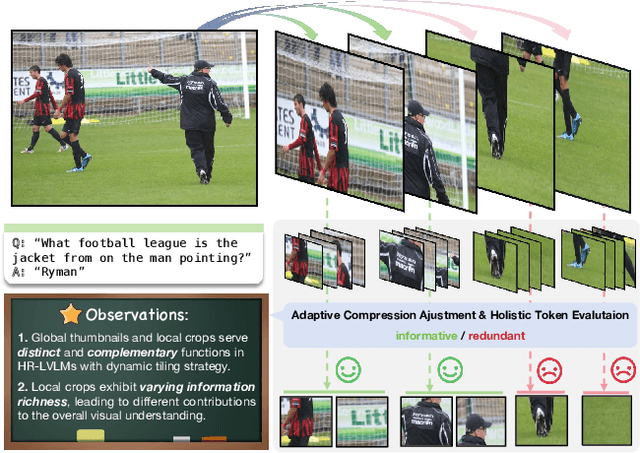
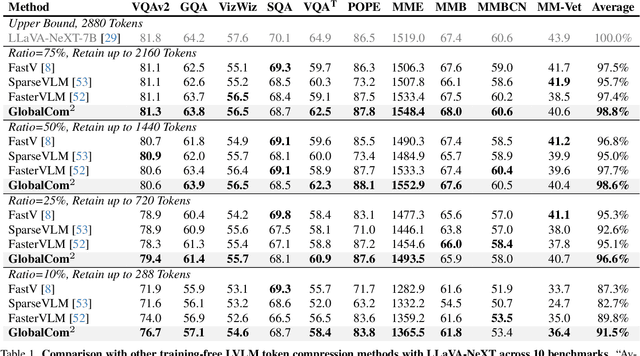
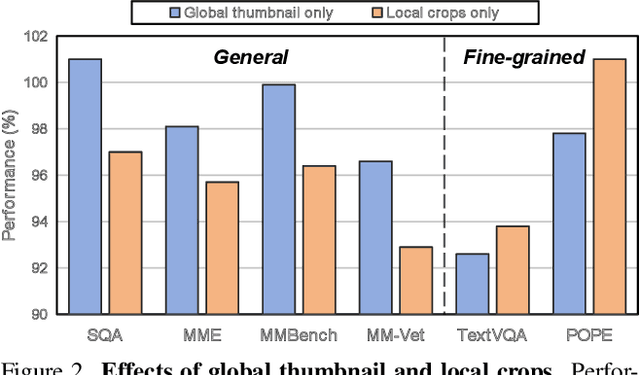
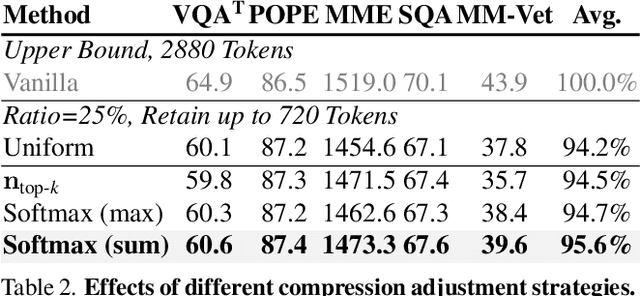
Multimodal large language models (MLLMs) have attracted considerable attention due to their exceptional performance in visual content understanding and reasoning. However, their inference efficiency has been a notable concern, as the increasing length of multimodal contexts leads to quadratic complexity. Token compression techniques, which reduce the number of visual tokens, have demonstrated their effectiveness in reducing computational costs. Yet, these approaches have struggled to keep pace with the rapid advancements in MLLMs, especially the AnyRes strategy in the context of high-resolution image understanding. In this paper, we propose a novel token compression method, GlobalCom$^2$, tailored for high-resolution MLLMs that receive both the thumbnail and multiple crops. GlobalCom$^2$ treats the tokens derived from the thumbnail as the ``commander'' of the entire token compression process, directing the allocation of retention ratios and the specific compression for each crop. In this way, redundant tokens are eliminated while important local details are adaptively preserved to the highest extent feasible. Empirical results across 10 benchmarks reveal that GlobalCom$^2$ achieves an optimal balance between performance and efficiency, and consistently outperforms state-of-the-art token compression methods with LLaVA-NeXT-7B/13B models. Our code is released at \url{https://github.com/xuyang-liu16/GlobalCom2}.
Rethinking Token Reduction in MLLMs: Towards a Unified Paradigm for Training-Free Acceleration
Nov 26, 2024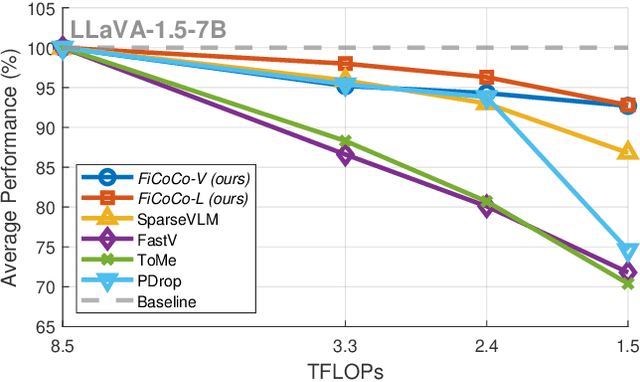
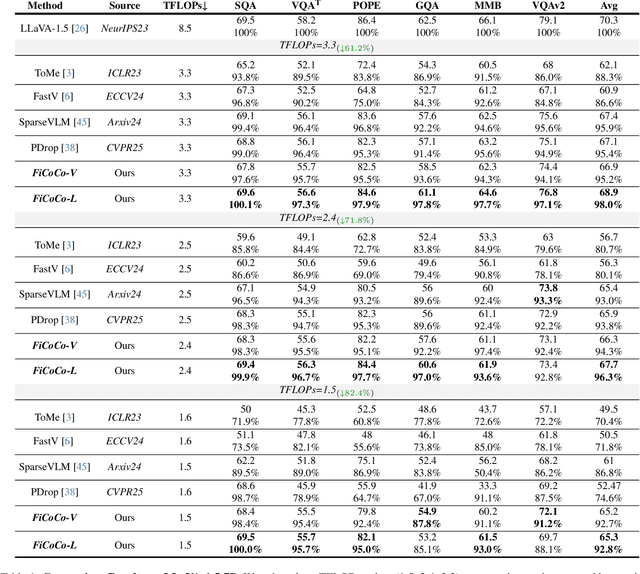
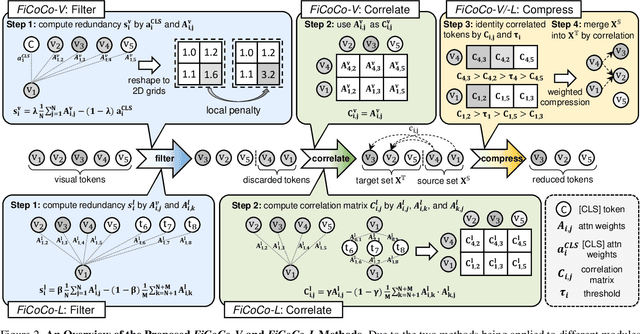
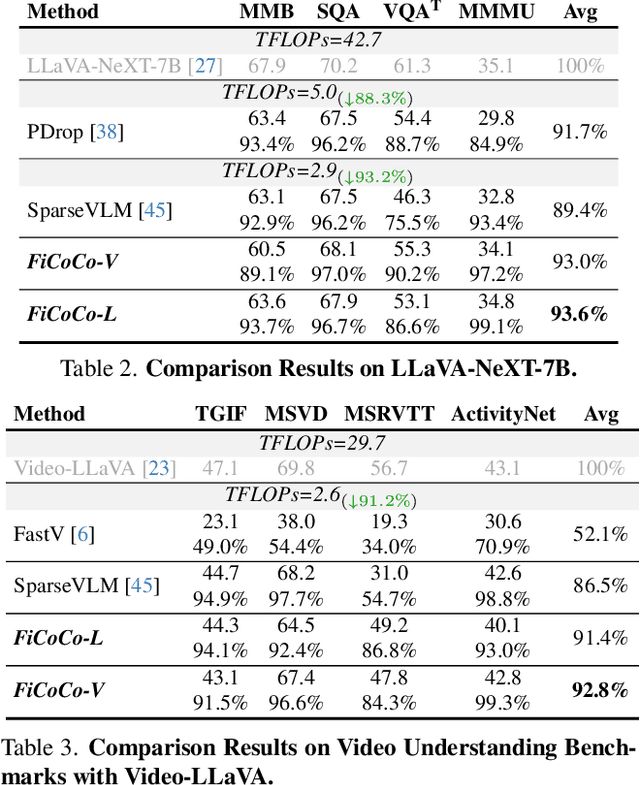
To accelerate the inference of heavy Multimodal Large Language Models (MLLMs), this study rethinks the current landscape of training-free token reduction research. We regret to find that the critical components of existing methods are tightly intertwined, with their interconnections and effects remaining unclear for comparison, transfer, and expansion. Therefore, we propose a unified ''filter-correlate-compress'' paradigm that decomposes the token reduction into three distinct stages within a pipeline, maintaining consistent design objectives and elements while allowing for unique implementations. We additionally demystify the popular works and subsume them into our paradigm to showcase its universality. Finally, we offer a suite of methods grounded in the paradigm, striking a balance between speed and accuracy throughout different phases of the inference. Experimental results across 10 benchmarks indicate that our methods can achieve up to an 82.4% reduction in FLOPs with a minimal impact on performance, simultaneously surpassing state-of-the-art training-free methods. Our project page is at https://ficoco-accelerate.github.io/.
DRAMA: An Efficient End-to-end Motion Planner for Autonomous Driving with Mamba
Aug 07, 2024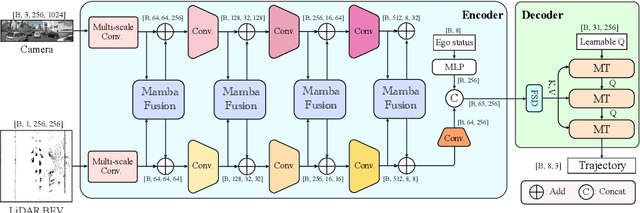
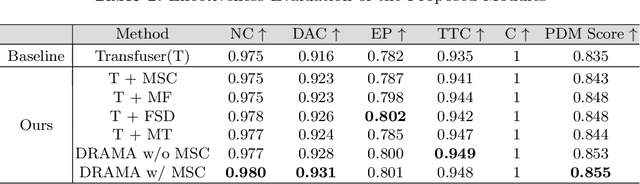

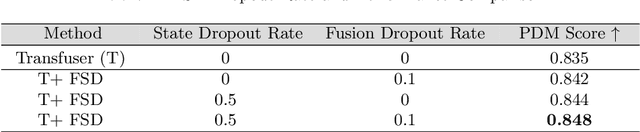
Motion planning is a challenging task to generate safe and feasible trajectories in highly dynamic and complex environments, forming a core capability for autonomous vehicles. In this paper, we propose DRAMA, the first Mamba-based end-to-end motion planner for autonomous vehicles. DRAMA fuses camera, LiDAR Bird's Eye View images in the feature space, as well as ego status information, to generate a series of future ego trajectories. Unlike traditional transformer-based methods with quadratic attention complexity for sequence length, DRAMA is able to achieve a less computationally intensive attention complexity, demonstrating potential to deal with increasingly complex scenarios. Leveraging our Mamba fusion module, DRAMA efficiently and effectively fuses the features of the camera and LiDAR modalities. In addition, we introduce a Mamba-Transformer decoder that enhances the overall planning performance. This module is universally adaptable to any Transformer-based model, especially for tasks with long sequence inputs. We further introduce a novel feature state dropout which improves the planner's robustness without increasing training and inference times. Extensive experimental results show that DRAMA achieves higher accuracy on the NAVSIM dataset compared to the baseline Transfuser, with fewer parameters and lower computational costs.
ADM: Accelerated Diffusion Model via Estimated Priors for Robust Motion Prediction under Uncertainties
May 01, 2024Motion prediction is a challenging problem in autonomous driving as it demands the system to comprehend stochastic dynamics and the multi-modal nature of real-world agent interactions. Diffusion models have recently risen to prominence, and have proven particularly effective in pedestrian motion prediction tasks. However, the significant time consumption and sensitivity to noise have limited the real-time predictive capability of diffusion models. In response to these impediments, we propose a novel diffusion-based, acceleratable framework that adeptly predicts future trajectories of agents with enhanced resistance to noise. The core idea of our model is to learn a coarse-grained prior distribution of trajectory, which can skip a large number of denoise steps. This advancement not only boosts sampling efficiency but also maintains the fidelity of prediction accuracy. Our method meets the rigorous real-time operational standards essential for autonomous vehicles, enabling prompt trajectory generation that is vital for secure and efficient navigation. Through extensive experiments, our method speeds up the inference time to 136ms compared to standard diffusion model, and achieves significant improvement in multi-agent motion prediction on the Argoverse 1 motion forecasting dataset.
ControlMTR: Control-Guided Motion Transformer with Scene-Compliant Intention Points for Feasible Motion Prediction
Apr 17, 2024
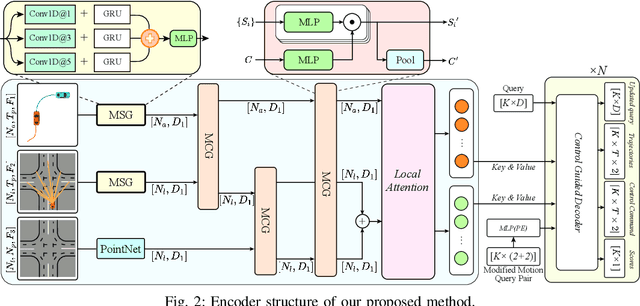


The ability to accurately predict feasible multimodal future trajectories of surrounding traffic participants is crucial for behavior planning in autonomous vehicles. The Motion Transformer (MTR), a state-of-the-art motion prediction method, alleviated mode collapse and instability during training and enhanced overall prediction performance by replacing conventional dense future endpoints with a small set of fixed prior motion intention points. However, the fixed prior intention points make the MTR multi-modal prediction distribution over-scattered and infeasible in many scenarios. In this paper, we propose the ControlMTR framework to tackle the aforementioned issues by generating scene-compliant intention points and additionally predicting driving control commands, which are then converted into trajectories by a simple kinematic model with soft constraints. These control-generated trajectories will guide the directly predicted trajectories by an auxiliary loss function. Together with our proposed scene-compliant intention points, they can effectively restrict the prediction distribution within the road boundaries and suppress infeasible off-road predictions while enhancing prediction performance. Remarkably, without resorting to additional model ensemble techniques, our method surpasses the baseline MTR model across all performance metrics, achieving notable improvements of 5.22% in SoftmAP and a 4.15% reduction in MissRate. Our approach notably results in a 41.85% reduction in the cross-boundary rate of the MTR, effectively ensuring that the prediction distribution is confined within the drivable area.